

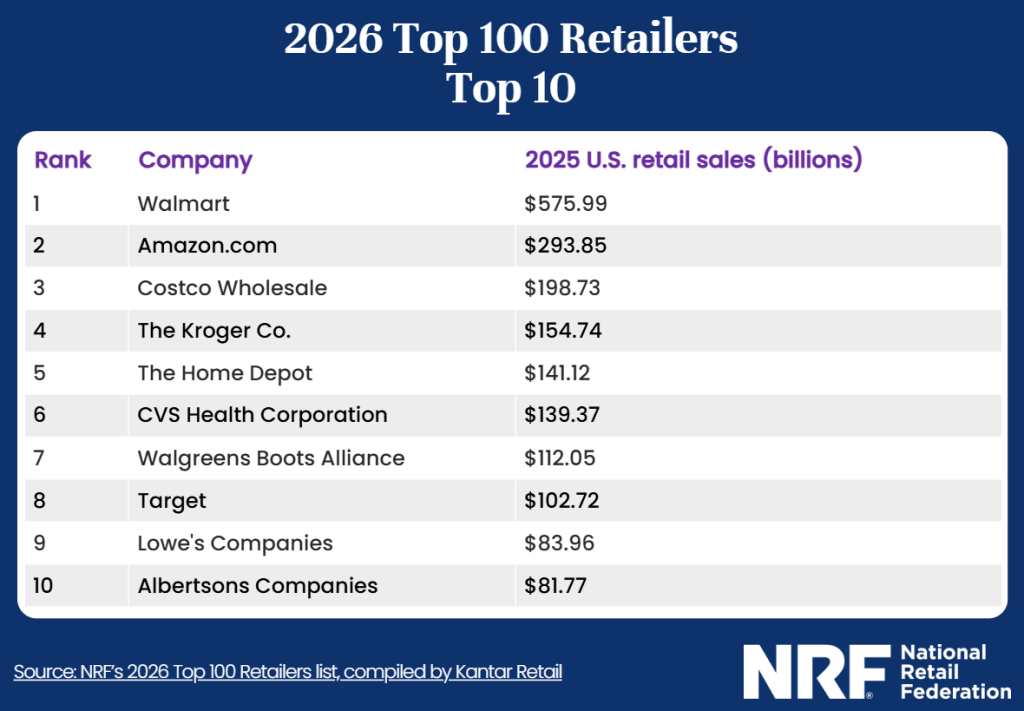
Walmart and Amazon have retained their positions at the top of the US retail market in the latest 2026 Top 100 Retailers ranking published by the National Retail Federation.
The annual list tracks the largest US-based retail companies by sales and is closely watched across the global retail industry as a benchmark for scale, competition and structural change.
Go deeper with GlobalData


Discover B2B Marketing That Performs
Combine business intelligence and editorial excellence to reach engaged professionals across 36 leading media platforms.
The ranking again shows the strength of large multi-category retailers and e-commerce platforms, with established players continuing to dominate overall sales volumes.
It also reflects a market that remains highly concentrated at the top, even as competition intensifies across physical stores and digital channels.
Top positions
The 2026 list confirms that Walmart and Amazon remain the leading forces in US retail.
Walmart continues to rely on its large physical store network alongside growing digital operations, while Amazon maintains its position through its e-commerce scale, logistics infrastructure and marketplace model.
The report highlights how both companies benefit from broad product ranges, strong supply chains and established customer bases. These advantages continue to support their dominance in a market where price sensitivity and convenience remain key purchasing drivers.
Digital growth
A key theme in the 2026 ranking is the continued expansion of online retail alongside physical store networks.
Amazon remains the clearest example of digital-first retail at scale, but many traditional retailers are also increasing their investment in online platforms, delivery services and store-based fulfilment.
Warehouse clubs, including Costco, continue to perform strongly, supported by steady demand for grocery and household essentials. Their membership models provide predictable revenue streams, which has helped them maintain stable positions in the ranking.
Across the sector, retailers are increasingly operating hybrid models, combining digital ordering with physical infrastructure to manage fulfilment, returns and customer service.
Market pressure
The 2026 ranking also reflects ongoing pressure across the retail industry, particularly in balancing cost control with investment in technology and logistics.
Retailers are adapting to shifting consumer behaviour, where value, convenience and availability remain central to purchasing decisions. At the same time, competition between large chains continues to intensify, especially in categories such as grocery, general merchandise and home goods.
The NRF data suggests that scale remains a decisive advantage. Larger retailers are better positioned to invest in automation, data systems and distribution networks, reinforcing the gap between market leaders and smaller competitors.
As the US retail landscape continues to evolve, the latest ranking underscores a stable but highly competitive top tier, where Walmart and Amazon remain firmly at the centre of global retail attention.
Dive deeper into the retail landscape with NRF’s 2026 Top 50 Global Retailers and 2025 Hot 25 Retailers rankings.


