


Sérgio Correia, a bedding manufacturer in Rio Mau, northern Portugal, has made bedsheets, bedspreads and duvets since 2001. The family firm runs its own factory and employs more than 60 people, most of them from around the area. For two decades almost all of its product reached Portuguese homes through wholesalers and resellers.
The company had tried selling directly through its website and other online marketplaces, with modest results, roughly 10 orders a day. In September 2025 it listed on Temu under the brand Blume for Home. Within weeks it was racking up to 150 orders in a day, a 15-fold increase on previous levels.
“The impact on volume was massive,” said Inês Barbosa, the company’s marketing manager. “It was just me handling everything at first, and I had to ask for help.” While wholesale remains the core of the business, the company is now planning to expand direct sales to consumers in other countries through Temu.
The Portuguese manufacturer’s experience points to a shared challenge for Europe’s small businesses: having a product is one thing, reaching new markets is another. That issue sits at the heart of Temu’s Small Business Insights Report 2026, which draws on seller experiences and discussions with business groups across Europe.
How many European small businesses sell online?
Eurostat data shows that only around a fifth of small firms in the EU made online sales in 2024. In other words, roughly four in five did not. That matters because small businesses form the backbone of Europe’s economy. Across OECD countries, SMEs employ roughly two-thirds of workers and generate more than half of all goods and services.
What stops small firms from going online?
Since January 2026, Temu has held more than 100 meetings with trade associations, chambers of commerce, start-up networks and investment bodies across Europe to understand the factors holding back online commerce. The organisations described barriers in three areas:
- Complexity: Many small businesses lack the time, expertise and confidence to go digital. This is compounded when they go cross-border and have to handle multi-market logistics, product safety rules, extended producer responsibility (EPR) obligations, and VAT administration.
- Cost: There are many different costs for selling online, including bills for software, logistics, staffing and compliance. These costs are incurred before the first sale is made, which deter many small businesses from pursuing online sales.
- Connection: Sellers want to know who they can contact directly when something goes wrong. Some described platforms with no account manager, where questions were met with automated replies.
How does Temu reduce the complexity of selling online?
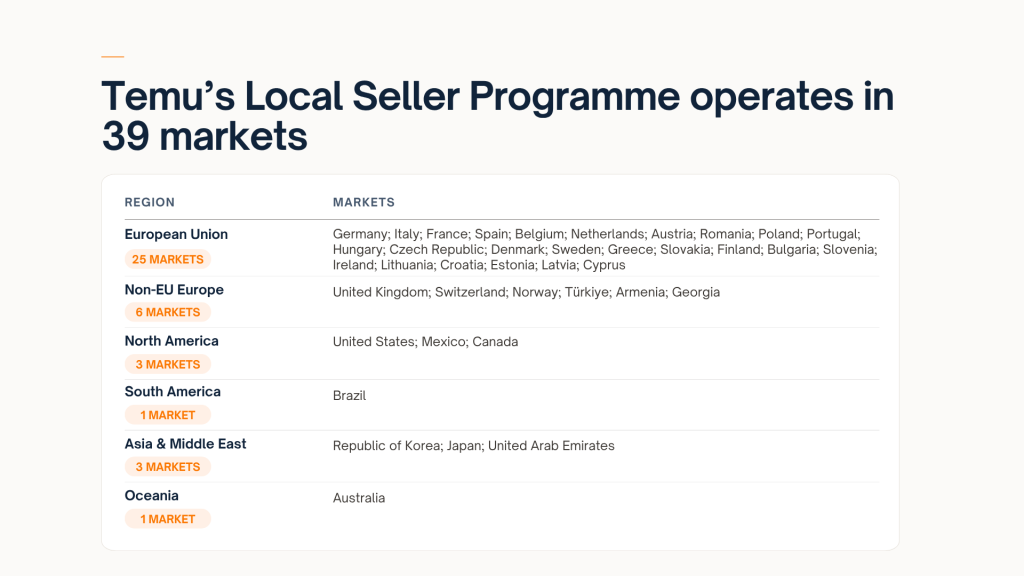
Temu’s Local Seller Programme lets businesses in more than 25 European countries sell on the platform without registration or listing fees. The programme, live in 39 markets globally and launched in Europe in 2024, also covers the United Kingdom, Switzerland and Norway. Eligible sellers can list across more than 700 categories, including household goods and everyday essentials.
Sellers can build a storefront with the platform’s tools, typically in under a week, or connect an existing web store through third-party integrations. The platform links to more than 200 enterprise resource planning partners, including Rithum and Linnworks, as well as payment methods used in individual markets.
For sellers ready to grow beyond their home market, the programme is also the gateway to international sales, giving small businesses a practical way to expand without building operations from scratch each time they enter a new market.
EPR registrations, declarations and payments can be handled through the platform’s Pay-on-Behalf framework, which covers more than 60 producer responsibility organisations across the EU. This simplifies registration for sellers across covered markets.
Product testing and certification are available through partners including SGS, Bureau Veritas and QIMA.
How does Temu lower the cost of shipping across Europe?
For many small businesses, logistics was the key concern. Packaging, last-mile delivery and multi-country fulfilment can be prohibitively expensive for a small operation. Larger firms absorb this by spreading costs over a bigger revenue base. SMEs rarely have that option, and for some it rules out e-commerce entirely.
Rather than ask sellers to build delivery infrastructure, Temu works with more than 150 logistics providers across Europe, including national postal operators such as DHL, La Poste and CTT. Temu estimates that sellers save 30% to 40% against standard single-carrier rates on corridors such as Germany to France.
These partnerships run through channels established operators already own rather than a parallel system.
What support do sellers get when something goes wrong?
Temu assigns each seller a named point of contact and a dedicated onboarding and support team, covering compliance, logistics and platform operations.
Temu’s safety tools screen listings for authenticity before and after they go live, and listings that fail those checks are removed to protect legitimate sellers. Its Brand Guardian Initiative, launched in 2024, lets brands and rights holders report counterfeits and request removal directly.
Temu also offers practical guidance through training and joint events for firms selling online for the first time or looking to grow. It has signed memorandums of understanding with industry bodies across Europe, including Start:up Slovenia, the Swiss SME association Schweizerischer KMU Verband and the Portuguese Association for the Development of Communications, with programmes running into 2027.
In July 2026 Temu joined Cross-Border Commerce Europe, an industry association, and takes part in its accelerator programme and its work on cross-border e-commerce policy.
What do sellers report after joining Temu?
In June and July 2026, Temu surveyed more than 150 active local sellers across Germany, France, Spain, Italy, Poland and the UK.
Half (50%) said they had increased production capacity, hired staff, or both since joining Temu. Around a third (34%) had expanded into new international markets. About three-quarters (75%) described Temu as either an important additional sales channel or their primary one. For most of these firms, selling on Temu adds a route rather than replacing one.
AMF Creation opened a Temu storefront in 2024, looking to diversify and jumpstart sales. The German manufacturer started in 2010 and built its name on reusable water-repellent nonwoven table linen, before expanding into home and garden ranges. But sales through existing marketplaces had flattened while advertising costs climbed and traffic fell.
On Temu, daily orders climbed from zero to 100 within days. Marcus Fochler, founder and CEO of AMF Creation credits the guidance he received from Temu representatives, which taught him to read demand trends and customer signals and feed them back into production decisions. The company now plans to launch new product lines and enter further markets. “It turned out the problem wasn’t the products,” Fochler said. “It was where they were being sold.”
