
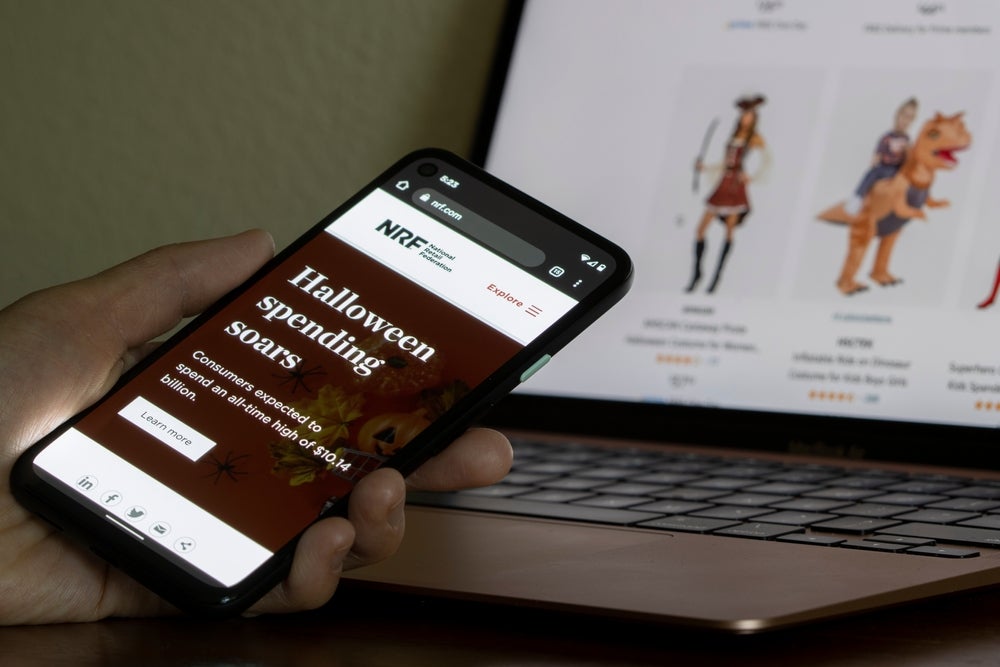
Nearly half of US consumers are using artificial intelligence tools to help with their Halloween shopping this year, according to a survey by the National Retail Federation (NRF).
The survey found that 47% were using AI platforms or tools to support their Halloween shopping. The NRF cited brainstorming ideas and seeking recommendations during product research as leading uses, at 34% and 32% respectively. Its published results do not establish whether AI influenced what shoppers ultimately bought.
The findings suggest that some shoppers may begin looking for costume or decoration ideas before visiting a retailer’s website or store.
Shoppers start earlier
Almost half of respondents, 49%, planned to begin Halloween shopping in September or earlier. That compares with 34% in 2016.
Among those shopping early, 42% said they did so because they looked forward to the autumn season. Promotions were a reason for 21%, while 23% said shopping early helped them spread the cost.
Spending forecast to rise
The NRF forecasts US Halloween spending of $13.5bn in 2026, compared with last year’s record of $13.1bn. Expected spending per person is $115.14, broadly in line with 2025. Some 74% of respondents planned to celebrate Halloween.
Confectionery was the most widely planned purchase, cited by 96% of consumers, followed by decorations at 78% and costumes at 71%.
Discount stores remained the most frequently cited shopping destination, at 39%, followed by specialist Halloween and costume shops at 32%. Some 27% planned to shop online. Respondents could plan to use more than one destination.
AI joins the discovery process
For retailers outside the US, the survey offers a view of how AI can fit into seasonal product discovery. It shows substantial reported use during Halloween planning and research, but does not measure its effect on sales or establish whether the same behaviour is occurring in other markets.
The findings also do not show whether consumers who use AI are more likely to purchase online or in physical stores. They point instead to a change in the earlier stages of the shopping journey, when consumers are developing ideas and researching products.
Prosper Insights & Analytics surveyed 7,889 US consumers for the NRF from 1 to 9 September 2026. The survey’s stated margin of error is plus or minus 1.1 percentage points.