

Retailers are investing billions in loss prevention, but the challenge is no longer choosing between people and technology. It is knowing where human judgement remains essential.
UK retailers have invested almost £5.5bn in loss-prevention measures over the past five years, from security personnel and CCTV to data collection and other technologies. The scale of that investment reflects the continuing cost and complexity of retail crime.
There are signs of progress. The British Retail Consortium (BRC) recorded 1,600 incidents of violence and abuse against retail workers a day in the year to August 2025, down from 2,000 a day the previous year. But the figure remains far above the pre-pandemic level of 455 incidents a day in 2019/20.
Meanwhile, police-recorded shoplifting in England and Wales fell 4% to 507,086 offences in the year ending March 2026. The Office for National Statistics (ONS) warns, however, that reporting rates for shoplifting are known to be very low, meaning recorded offences do not represent the full scale of the problem.
Against this backdrop, retailers face a strategic question. As CCTV, analytics, body-worn cameras and other security technologies become more capable, what does a security guard provide that technology cannot?
Increasingly, the answer is not substitution but integration.
Technology can detect incidents, identify patterns and collect evidence at a scale that people cannot. Security personnel provide something different: human judgement, communication and the ability to respond to situations as they unfold on the shop floor.
For retailers, the challenge is deciding which risks require people, which can be managed through technology and how the two should work together.
Retail crime keeps security high on the agenda
Shoplifting remains a major challenge for retailers. The latest ONS figures show more than half a million police-recorded shoplifting offences in England and Wales in the year ending March 2026, despite the 4% annual decline. The ONS also notes that closer engagement between police and retailers has contributed to improved reporting, while many incidents still go unreported.
The problem is not limited to the value of stolen goods. The BRC recorded 5.5 million detected incidents of shop theft in the year covered by its 2026 crime report, with customer theft accounting for the largest share of known losses. Organised criminal groups are also increasingly targeting high-value goods that can be easily resold.
The wider risk is human as well as financial. Theft can put employees at risk when suspected offenders are challenged, while violence and abuse can occur whether or not a theft is involved.
That combination helps explain why retailers continue to invest heavily in security even as the technology available to them becomes more sophisticated.
Keeping employees out of confrontations
Loss prevention has traditionally focused on merchandise and financial loss. Employee safety is now an equally important part of the security equation.
The BRC's latest figures show that violence and abuse against retail workers remains at historically high levels. Around 590,000 incidents were recorded in 2024/25, including physical violence and incidents involving weapons.
This creates a difficult operational balance. Retailers need to respond to theft and disorder, but sales assistants, checkout staff and other store colleagues should not be expected to put themselves in unnecessary danger.
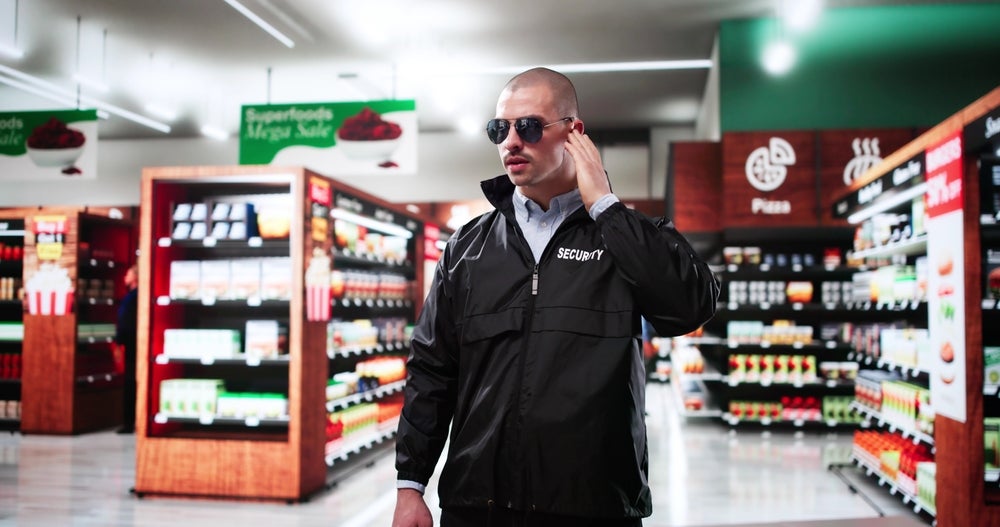
Dedicated security personnel can provide a clearer division of responsibility. Depending on the retailer's policies and the role they are contracted to perform, guards can observe suspicious behaviour, support colleagues during incidents, manage confrontational situations, preserve evidence and determine when an incident should be escalated to management or the police.
That allows other employees to focus on customers rather than becoming the frontline response to security incidents.
The value of guarding therefore extends beyond protecting merchandise. A trained security presence can give retailers a dedicated resource for dealing with threatening, disruptive or potentially dangerous situations while reducing the pressure on other employees to intervene.
Detection is not the same as response
Technology has become an increasingly important part of modern retail security. CCTV, electronic article surveillance, body-worn cameras, access-control systems and data-driven loss-prevention tools can help retailers detect incidents, gather evidence and identify patterns across multiple stores.
But detecting an event and managing it are different tasks.
A camera can record suspicious behaviour. Analytics can identify patterns. An automated system can generate an alert. Data from multiple incidents can help retailers identify repeat offending, vulnerable locations and periods of elevated risk.
None of those capabilities necessarily resolves what is happening on the shop floor.
A trained security professional can assess a situation in context, communicate with employees and customers, manage an escalation and, where appropriate, liaise with the police. Human judgement becomes particularly important when an incident does not fit neatly into the parameters of an automated alert.
Technology can also make guarding more targeted.
Rather than relying entirely on guards to identify problems through observation, security systems can direct their attention towards particular incidents, locations or periods of heightened risk. This can potentially make a smaller or more strategically deployed security team more effective.
For retailers under pressure to control operating costs, the objective should therefore be to identify where technology can manage risk efficiently and where human judgement provides additional value.
The relationship between people and technology matters more than the choice between them.
Building the business case for security guards
The case for security personnel should be based on risk rather than assumption.
Store location, opening hours, footfall, merchandise value, previous incidents and patterns of offending can all influence the appropriate security model. That can mean very different requirements across the same retail estate.
A high-risk location might justify a permanent guarding presence. Another store may need additional security only at particular times of day or during periods of elevated risk. Elsewhere, improved CCTV coverage, electronic security, store design or operating procedures may provide a more proportionate response.
Retail format matters too. A luxury boutique selling high-value merchandise has different requirements from a supermarket experiencing frequent shoplifting. Convenience stores, shopping centres and department stores present their own combinations of risk, customer interaction and operating conditions.
Retailers must also consider how a visible security presence affects the customer experience. Too little security can leave employees and customers exposed, while an overly intrusive presence can undermine the environment a retailer is trying to create.
That makes the skills of security personnel important as well as their visibility. Observation, communication, conflict management and de-escalation can help guards manage risk without unnecessarily disrupting the shopping environment.
Responsibilities should be clearly defined, including how security personnel should respond to suspected theft, aggression and emergencies; when store employees should seek their assistance; and when incidents should be handed to the police.
The objective is not to maximise the number of guards. It is to deploy the right security capability against the risks each store actually faces.
Measuring the value of security
Deciding where guards are needed is only part of the equation. Retailers also need to determine whether the investment is delivering results.
Guard numbers alone reveal little about effectiveness. A security presence that is poorly trained, inadequately supervised or deployed in the wrong locations may deliver limited value regardless of its cost.
Retailers can instead examine outcomes such as shrink, incident frequency and severity, repeat offending, employee safety, response times and the quality of evidence collected following incidents.
These measures can help determine whether additional security personnel are required or whether investment would be better directed elsewhere.
Repeated incidents in one area of a store, for example, might indicate a need for better surveillance, a change in layout or improved stock controls rather than another guard. A location experiencing frequent aggressive incidents may place greater value on trained personnel capable of supporting employees and managing confrontations.
Treating guarding as a measurable operational investment, rather than simply a security overhead, can help retailers identify where people provide the greatest value.
Building an integrated retail security strategy
No guarding model operates in isolation.
Security personnel need to work alongside CCTV, electronic security, store design, employee training, incident reporting, stock controls and relationships with law enforcement.
Data is increasingly important to that integration. Incidents that appear isolated at individual stores may reveal wider patterns when information is analysed across a retail estate. Repeat offenders, targeted products, common methods and higher-risk periods can then influence where security resources are deployed.
Police cooperation is another important component. The ONS notes that police are actively encouraging retailers to report shoplifting and submit supporting evidence such as CCTV to strengthen intelligence, identify offenders and link related offences.
The legal framework is also changing. The Crime and Policing Act 2026 creates a standalone offence of assaulting a retail worker in England and Wales and removes the previous special treatment of shop theft involving goods worth £200 or less.
But legislation and police enforcement cannot remove the need for retailers to manage immediate risks within their stores.
Effective retail security ultimately depends on how its different elements connect: employees identifying and reporting incidents, technology detecting and recording them, security personnel managing situations on the ground, and police investigating and pursuing offenders where appropriate.
Finding the right place for people
The continuing scale of retail crime does not mean every retailer needs more guards in every store.
Technology, store design, employee training, data analysis and police cooperation can all reduce risk or allow security resources to be deployed more efficiently. The more useful question is what each part of the security operation does best.
Technology can monitor stores, detect events, connect data and collect evidence at a scale that people cannot. Police and the criminal justice system have powers that private security personnel do not.
Security guards provide something different: a trained human presence able to assess an unfolding situation, support employees and customers, and manage a response on the shop floor.
The case for guarding therefore depends less on headcount than on where that human capability is needed most.
For retailers, the challenge is to identify those situations and integrate security personnel with technology, data, store operations and law enforcement.
The most effective retail security model is unlikely to be people or technology. It is more likely to be the right combination of both, deployed according to the risks each store actually faces.